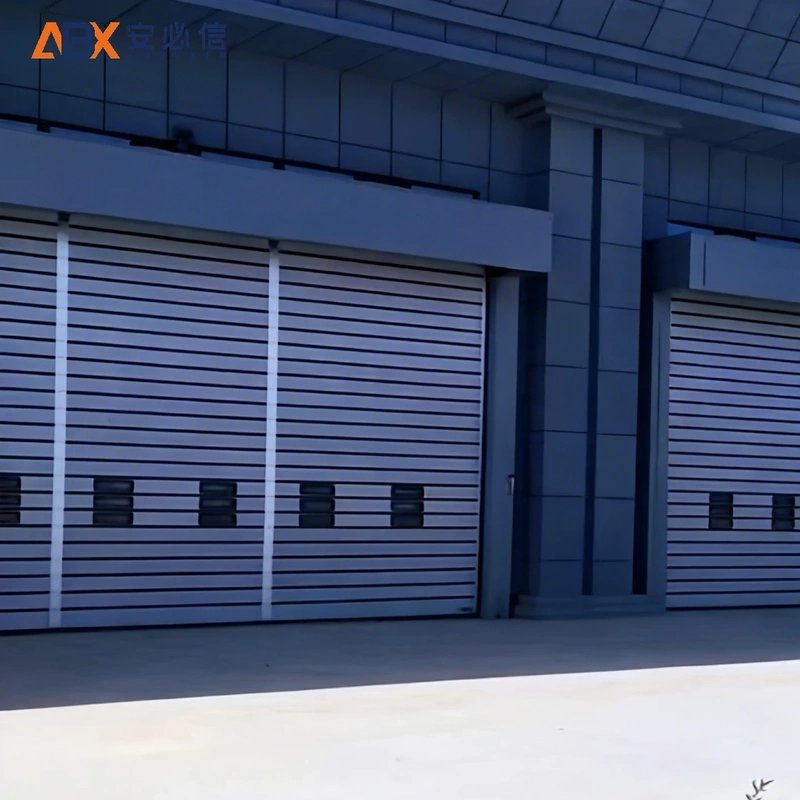
Fire-Rated Overhead Door Solutions for the Food Industry is a set of door, sealing and control configurations for food processing plants, where the main concerns are hygiene zoning, washdown cleaning, and pest and dust exclusion. A rigid high-speed door is a powered industrial door built from rigid insulated slats that opens and closes at high speed, combining wind resistance, security and temperature separation at high-traffic openings.
Configuration by opening position in food production and processing areas
The table maps positions that commonly appear in food processing plants to the configuration items that belong in the door schedule. On this page the review focuses on air infiltration and energy loss.
| Opening position | Configuration to verify |
|---|---|
| Dry goods warehouse portal | Heated guides where condensation or frost is expected — Control dust migration between storage areas |
| Between raw and ready-to-eat zones | Wind class verified against EN 12424 for the building elevation — Define the hygiene boundary and keep the opening time short |
| Washdown production entrance | Rigid insulated slat package with spiral guide — Specify cleanable surfaces and an accessible header zone |
| Chilled-to-ambient transfer | Bottom airbag seal plus side sealing gaskets — Manage condensate at the guides and the threshold |
Configuration detail
- Bottom airbag seal plus side sealing gaskets
- Variable-frequency drive with soft start/stop
- Safety edge and photocell coverage across the opening
- Heated guides where condensation or frost is expected
- Wind class verified against EN 12424 for the building elevation
Where this construction is not the first choice
For very large spans or strongly flexible openings, a stacking door is usually a better structural match than a rigid slat curtain.
Specifying rigid high-speed doors for food processing plants
For food processing plants, the starting point is structural strength and wind resistance. It combines a fast cycle with a rigid, sealed curtain, so the opening can stay on an exposed elevation without losing its wind class or its temperature separation. The checks below should be resolved against the project door schedule before an order is placed.
- Record the expected daily cycle count against the drive duty rating.
- Specify the safety devices and their interlocks with adjacent equipment.
- Check the sealing arrangement at the threshold and the side guides.
- Agree the service interval and the spare parts held on site.
- Confirm the clear opening width and the available headroom for the slat stack.
Frequently asked questions
What is Fire-Rated Overhead Door Solutions for the Food Industry?
Fire-Rated Overhead Door Solutions for the Food Industry is a set of door, sealing and control configurations for food processing plants, where the main concerns are hygiene zoning, washdown cleaning, and pest and dust exclusion.
What reduces energy loss most at a busy opening?
Reducing the time the aperture is open and specifying a continuous perimeter seal; insulation of the leaf alone has a smaller effect than either.
Why are rigid high-speed doors considered for food processing plants?
It combines a fast cycle with a rigid, sealed curtain, so the opening can stay on an exposed elevation without losing its wind class or its temperature separation. Forklift traffic between production, packing and cold storage sets the real cycle count and the required visibility through the opening.
Which configuration items should be stated in the door schedule?
At minimum: Wind class verified against EN 12424 for the building elevation; Rigid insulated slat package with spiral guide; Bottom airbag seal plus side sealing gaskets. Final values depend on the measured opening and the site conditions.
Where rigid slat construction changes the specification
Because the curtain is made of rigid insulated slats, the opening keeps a defined plane under pressure difference. This is the reason rigid doors are selected for external bay entrances where a flexible curtain would billow or leave the guides.
Sealing, insulation and condensation
Insulated slats reduce heat transfer across the opening, but the perimeter seals and the interface with the building structure usually dominate the real energy loss. A door schedule should state the sealing arrangement, not just the panel thickness.
Air infiltration and energy loss
Energy loss in food processing plants is dominated by air exchange while the aperture is open, not by conduction through the door leaf. Short, well-timed cycles matter more than a thicker panel.
With the rigid high-speed door, the perimeter seals and the interface with the building structure determine the leakage when closed; the closing delay determines it while in motion.
Operating conditions in food processing plants
Forklift traffic between production, packing and cold storage sets the real cycle count and the required visibility through the opening.
- Hygiene zoning separates raw, processed and packaged goods; each transfer point is a potential cross-contamination route.
- Washdown routines expose the door, guides and header box to water and cleaning agents, so surfaces must be accessible and the materials compatible.
- Pest and dust exclusion depends on how short the opening time is and how well the closed door seals at the threshold.
- Chilled and ambient zones sitting next to each other create condensation at the door interface, especially around the guides.
Standards and parameters to verify
Review the following against the measured opening and the site conditions before confirming an order. The standards named are the references normally used when reviewing an industrial door specification; they are not a certification claim for any specific installation.
| Reference | What to verify |
|---|---|
| EN 12428 | Thermal transmittance where temperature separation is required |
| EN 12453 | Safety in use of power-operated doors |
| EN 12604 | Mechanical aspects of doors and gates |
| EN 13241 | Product standard for industrial, commercial and garage doors and gates |
| EN 12424 | Wind resistance classification for the exposed elevation |
| EN 12425 | Resistance to water penetration |
| EN 12426 | Air permeability of the closed door |
| Typical operating speed | 0.5-1.2 m/s across models in this product family; confirm the required cycle time before selection. |
Final values for rigid high-speed doors depend on opening size, cycle duty and site conditions.
Gallery