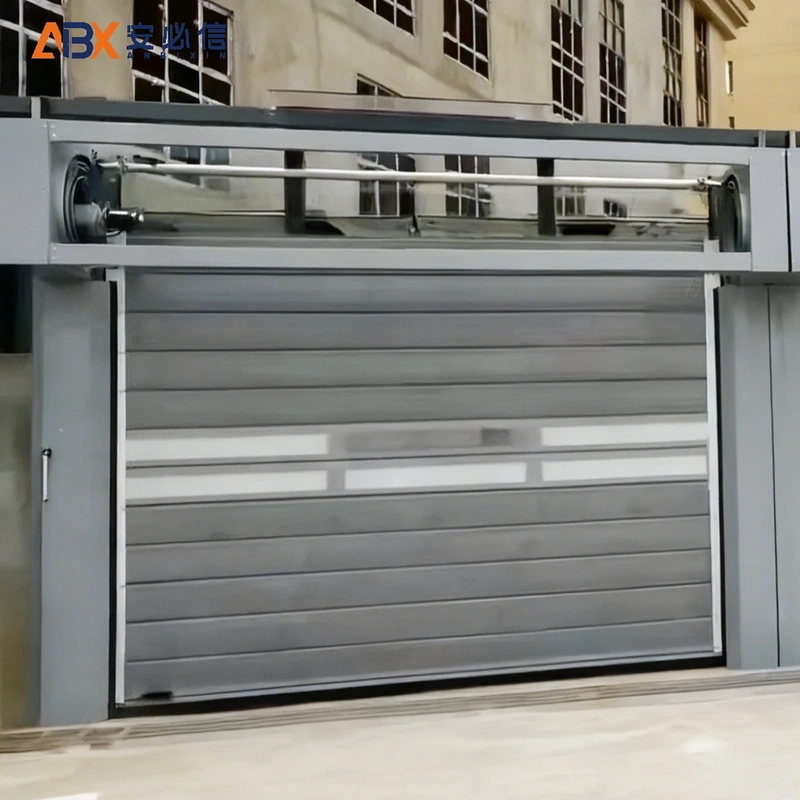
A rigid high-speed door and a sectional overhead door both close an industrial opening with a rigid leaf, but they optimise different things. The high-speed door minimises open time on a busy route; the sectional door maximises insulation and sealing where the opening stays closed for long periods.
The operating pattern decides more than the product
If an opening cycles two hundred times a day, the open time dominates the energy loss and the door has to be fast. If it opens twice a day and stays closed overnight, the insulation and the seal dominate and speed is irrelevant.
| Operating pattern | Better match | Why |
|---|---|---|
| High cycle, short open time | Rigid high-speed door | Open-aperture exchange is the main loss |
| Low cycle, long closed periods | Sectional overhead door | Conduction and perimeter leakage dominate |
| Dock bay with trailer sealing | Sectional door with dock seal | The shelter and the panel work as one envelope |
| Internal production transfer | Rigid high-speed door | Traffic throughput sets the requirement |
Sealing and thermal performance
A sectional door has a thicker panel and a continuous perimeter seal, and it can be combined with a dock shelter to close the gap around a trailer. That combination gives the lowest leakage on a loading bay.
A high-speed door has a thinner slat and a seal that is compressed by a fast-moving leaf. Its advantage is that the aperture is open for seconds rather than minutes, so the integrated leakage over a shift can be lower despite a worse closed-door figure.
Space, structure and headroom
A sectional door needs a horizontal track run inside the building, or a high-lift or vertical-lift arrangement where the ceiling is obstructed. A high-speed door needs a compact header zone but stronger jamb fixings for wind load.
In a building with a low soffit and obstructions, the high-speed door often fits where a sectional track cannot.
Safety and maintenance differences
The two constructions differ in what carries the load, which changes both the inspection scope and the risk profile.
- Sectional doors: spring balance, cables and hinges carry the load; spring and cable condition is the critical inspection.
- High-speed doors: guide wear, hinge play and bottom-edge function are the critical items.
- Both need a reversal test, but the high-speed leaf carries more energy per cycle.
- Sectional doors are slower, which changes the traffic procedure but not the safety principle.
Where a mixed solution is right
On a loading bay the two are often combined: a sectional door as the thermal closure and a high-speed door on the internal partition behind the dock. That separates the long-closed, insulated duty from the high-cycle traffic duty.
Retrofit constraints that decide it for you
In an existing building the choice is often made by the structure rather than by performance. A sectional door needs a horizontal track run, so a low soffit or a mezzanine above the opening can rule it out regardless of its thermal advantage. A rigid high-speed door needs a compact header but stronger jamb fixings, so a lightweight cladding wall can rule that out instead.
The survey that resolves this is short: measured headroom, the position of the first obstruction above the opening, the construction of the jambs and the available fixing depth. Those four facts usually leave one practical option, and the performance comparison then confirms it rather than deciding it.
Door count per bay
A bay that needs both a thermal closure and high-cycle traffic support ends up with two doors rather than one. That is a cost, but it separates two duties that no single door performs well, and it lets each door be serviced on its own schedule.
Related guides in this series
The following pages cover the adjacent decisions in the same product family, so the specification can be reviewed end to end.
- Complete guide to rigid high-speed doors
- Rigid versus PVC high-speed doors
- Insulation and air infiltration
- Cold store interfaces
References to verify before ordering
The table lists the references that normally change the selected configuration. It is a specification checklist, not a certification statement for any particular installation; the applicable class is confirmed against the measured opening and the site conditions.
| Reference | What has to be confirmed |
|---|---|
| EN 12428 | Thermal transmittance comparison |
| EN 12426 | Air permeability at the perimeter |
| EN 12424 | Wind class where either door is external |
| EN 12453 | Safety in use for both constructions |
| EN 12604 | Mechanical aspects of panels, springs and guides |
Frequently asked questions
Which door is better insulated?
A sectional door has the better closed-door insulation value. Whether that produces lower energy loss depends on how long the opening stays open.
Can a high-speed door replace a sectional door?
Where the opening is high-cycle, yes, and it usually reduces energy loss. Where the door is the main thermal closure for a cold store, the sectional panel is usually the better fit.
Which needs more headroom?
A sectional door needs a horizontal or vertical track run. A high-speed door needs a compact header zone, which is often easier to accommodate in an existing building.
Can both be used on the same bay?
Yes, and it is common: a sectional door at the external dock face and a high-speed door on the internal partition behind it.
Gallery