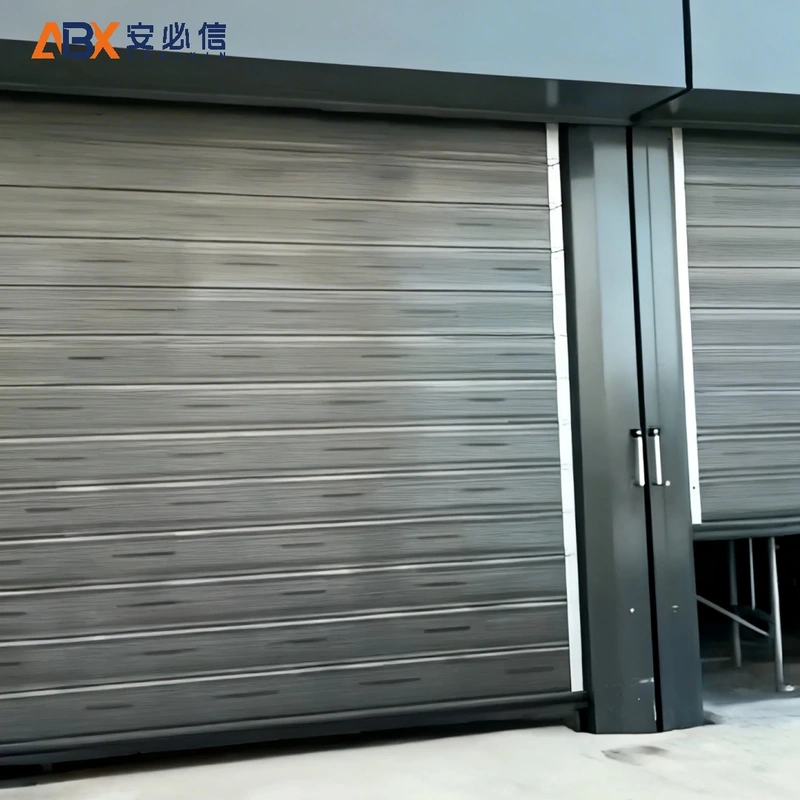
Spiral and turbine are two guide geometries for the same rigid slat leaf. A spiral guide winds the package into a shallow box; a turbine guide carries it through a curved shell with a deeper profile. The choice changes the header envelope, the wind load path and the access needed for service.
The mechanical difference
In a spiral guide the slats wind radially around a centre inside a box. The box is shallow but wide in the vertical direction. In a turbine guide the slats follow a curved shell that turns the package through a larger radius, which spreads the turning load over more slats and gives a more direct load path into the header.
Headroom and the parked envelope
The geometries differ in the envelope they need above the opening and in the way the turning load reaches the header.
| Aspect | Spiral guide | Turbine guide |
|---|---|---|
| Header depth | Shallow, compact box | Deeper curved shell |
| Parked envelope | Radial, grows with clear height | Curved, follows the shell radius |
| Suitability for retrofit | Good under an existing soffit | Needs more space above the opening |
| Services coordination | Easier to route around a shallow box | Greater risk of clash with ducts and sprinklers |
Wind and load behaviour
The turbine shell distributes the turning load across several slats at once and transfers it more directly into the header structure, which is why it is often chosen on exposed elevations with high cycle counts. The spiral guide relies on the box and the guide rails to carry the same load in a smaller envelope.
Both need a wind class appropriate to the elevation; the geometry changes how the load reaches the structure, not whether the elevation is exposed.
Service access and wear
A spiral box concentrates the guide curve in a small volume, which can make the curve segments harder to inspect without removing covers. A turbine shell is larger and typically gives better access to the roller path.
- Spiral: check cover fixings and debris accumulation in the box.
- Turbine: check the shell segments and the roller path along the curve.
- Both: inspect the park position for contact and the bottom edge for even compression.
Choosing between them
If the headroom is tight and the opening is sheltered or moderately exposed, the spiral guide is usually the practical choice. If the elevation is exposed, the cycle count is high and the structure can take a deeper header, the turbine shell gives a more direct load path and easier service access.
Supporting each header type
A spiral box is compact and concentrates its load at a few fixing points, so the header needs local reinforcement rather than a continuous beam. A turbine shell spreads its load along the curve, so it needs a continuous straight member over the full opening width.
That difference matters on retrofit work. Where the existing header is a sound continuous beam, the turbine shell is straightforward. Where it is a light lintel with good local strength but deflection between supports, the spiral box with local reinforcement is often the easier installation. Checking the header before choosing the geometry avoids discovering the constraint after the door is ordered.
What the choice means for delivery
Header geometry affects delivery as well as performance. A deeper shell usually means a larger transport envelope and more site lifting, while a compact box arrives in sections that two people can handle. On a retrofit with restricted access, that difference can decide the schedule.
Which geometry suits a high-security opening
Where the door is also the security closure, the geometry affects how the leaf resists being forced. A turbine shell holds the slats captive through a longer curve, so there are more points of engagement between the leaf and the guide. A spiral box relies on a shorter curve and a tighter radius. Neither is a security rating on its own, but the turbine arrangement is the more common choice where the opening is exposed and unattended.
Related guides in this series
The following pages cover the adjacent decisions in the same product family, so the specification can be reviewed end to end.
- Spiral construction
- Turbine hard-shell construction
- Wind load classes to EN 12424
- Complete guide to rigid high-speed doors
References to verify before ordering
The table lists the references that normally change the selected configuration. It is a specification checklist, not a certification statement for any particular installation; the applicable class is confirmed against the measured opening and the site conditions.
| Reference | What has to be confirmed |
|---|---|
| EN 12424 | Wind class for the elevation, independent of guide geometry |
| EN 12604 | Fixing loads transferred by the header and guides |
| EN 12453 | Safety during closing, common to both constructions |
| EN 12428 | Thermal performance where the door separates temperatures |
| EN 13241 | Product standard covering both guide types |
Frequently asked questions
Is a turbine door stronger than a spiral door?
The turbine shell distributes the turning load over more slats and gives a more direct load path, which helps on exposed elevations. Both are rigid doors and both need the correct wind class.
Which needs less headroom?
The spiral guide, because the package winds radially inside a shallow box.
Can a spiral door be used externally?
Yes, with the class established from the elevation. The geometry affects the load path, not the exposure.
Which is easier to maintain?
The turbine shell usually gives better access to the roller path; the spiral box requires cover removal for a full inspection.
Gallery