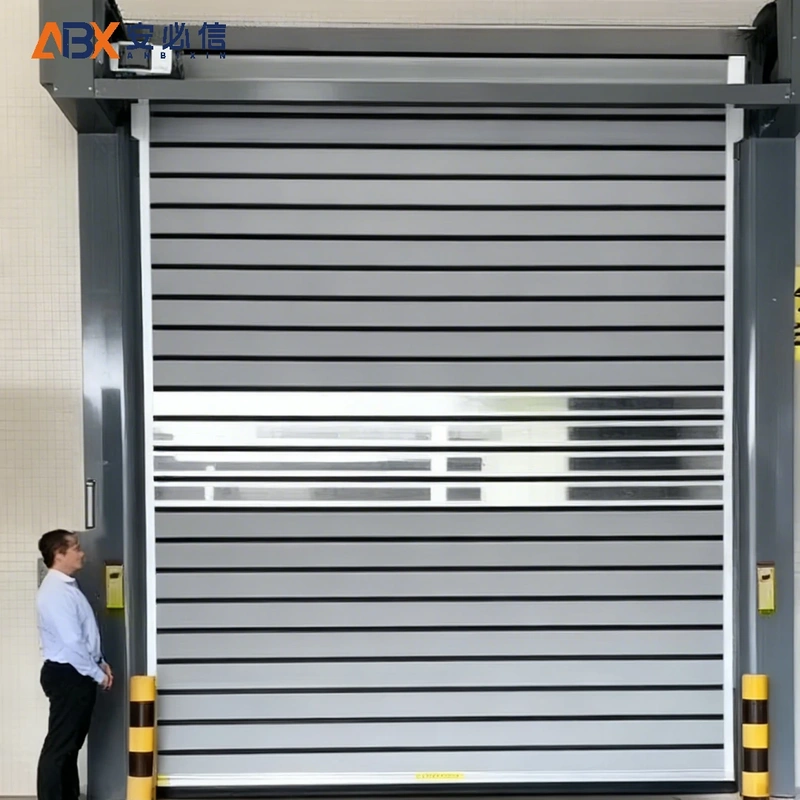
A spiral high-speed door is a rigid slat door in which the leaf winds into a spiral guide inside a shallow header box. The spiral keeps the parked package compact, so the door can provide a sealed, insulated closure where the available headroom above the opening is limited.
The geometry and why it saves headroom
In a spiral door the slats wind around a fixed centre inside the header box. The package grows radially rather than linearly, so the depth required above the opening is smaller than for a straight vertical lift of the same clear height.
That matters in existing buildings where the space above an opening is already occupied by ductwork, a crane rail or a mezzanine. The spiral box can often be fitted where a turbine or vertical-lift package cannot, without moving building services.
Where a spiral door is the natural choice
The construction suits openings that need a sealed and insulated closure but are not necessarily exposed to the worst weather. Typical positions are internal temperature boundaries, transfer corridors inside a plant and loading areas sheltered by a canopy.
- Cold-room and chilled-hall entrances under an existing soffit.
- Openings where a deep header zone would conflict with services.
- Internal partitions between conditioned and unconditioned production areas.
- Retrofit projects where the structural opening cannot be enlarged.
Sealing performance and the limits that come with it
The spiral box encloses the parked leaf and protects it from dust, which helps keep the seals clean and the guide free of debris. The closed leaf still depends on the perimeter seal, so the same rules apply as for any rigid door: the bottom seal, the side gaskets and the wall junction set the leakage.
The limit is exposure. A spiral door on an unsheltered elevation sees the same wind pressure as any other rigid door and needs the corresponding class; where the elevation is both exposed and very wide, a construction with a stronger guide load path is normally the better match.
Insulation, thermal bridging and frost
The slat joints are the same repeating thermal bridge as in any rigid slat door. The spiral box adds a second consideration: the parked package sits in an enclosed volume, and if that volume is cold and humid, moisture can condense on the slats while they are parked and drip when the door moves.
Ventilation or heating of the header box, a drainable threshold and a finish that tolerates washdown are the usual answers. Insulating the box itself is rarely enough if the guide remains the coldest path.
Commissioning and the settings worth recording
The spiral guide has to be aligned so the slats enter the curve without contact noise. Commissioning sets the travel limits, the deceleration ramp and the reversal sensitivity of the bottom edge, and confirms that the parked package does not touch the box at either limit.
| Setting | Why it is recorded | When it is revisited |
|---|---|---|
| Travel limits | Defines the parked and closed positions of the slat package | After any slat replacement |
| Acceleration ramp | Controls shock load on hinges at each cycle | After a change of duty |
| Closing delay | Balances traffic throughput against open time | After a traffic pattern change |
| Reversal sensitivity | Sets the force at which the bottom edge reverses | At every safety test |
| Cycle counter | Basis for the maintenance interval | Each service visit |
Cleaning and the inside of the box
The enclosed box protects the parked slats, but it also collects what the washdown water carries. In a food or pharmaceutical area the box interior is part of the cleaned surface, so the covers have to be removable without tools and the inside faces have to drain.
A box that traps water at its base will corrode at the lowest slat and drip onto the floor when the door opens. The practical detail is a sloped base with a drain point, covers that lift off, and no horizontal ledge above the opening where residue can sit. Those three decisions cost little at the design stage and are expensive to retrofit once the guides are fixed.
Related guides in this series
The following pages cover the adjacent decisions in the same product family, so the specification can be reviewed end to end.
- Complete guide to rigid high-speed doors
- Cold store interfaces and condensation
- Spiral versus turbine guide geometry
- Aluminium doors for wide openings
References to verify before ordering
The table lists the references that normally change the selected configuration. It is a specification checklist, not a certification statement for any particular installation; the applicable class is confirmed against the measured opening and the site conditions.
| Reference | What has to be confirmed |
|---|---|
| EN 12424 | Wind resistance class where the opening is on an external wall |
| EN 12428 | Thermal transmittance for the temperature boundary |
| EN 12426 | Air permeability of the closed door |
| EN 12453 | Safety in use of the power-operated leaf |
| EN 12604 | Fixing loads of the header box and guides |
Frequently asked questions
How much headroom does a spiral door need?
Less than a vertical-lift arrangement of the same clear height, because the package winds radially inside the box. The exact depth depends on the clear height and slat pitch and comes from the selected model, so it must be checked against the services above the opening.
Can a spiral door be installed in an existing building?
It is one of the more common retrofit choices for that reason. The shallow header box often fits under an existing soffit without relocating ductwork or sprinklers.
Is it suitable for a cold room entrance?
Yes, where the perimeter sealing and the threshold detail are specified for the temperature difference and condensate is managed at the guides and the floor.
Does the enclosed box remove the need for cleaning?
No. The box protects the parked leaf from dust but the guides, the bottom seal and the inside of the box still need inspection, and washdown areas need an accessible detail.
Gallery