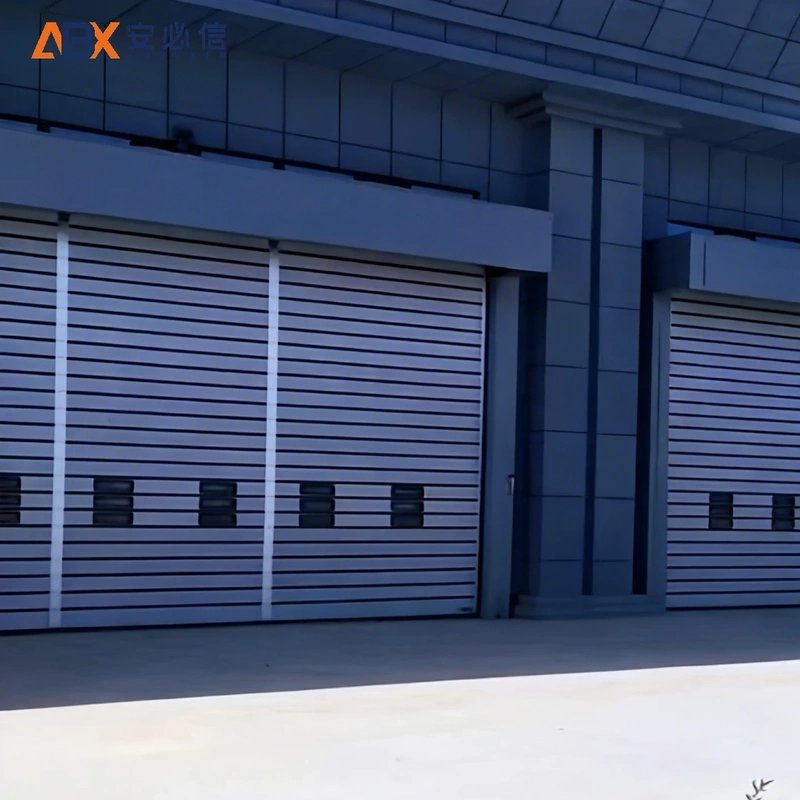
An aluminium high-speed door is a rigid slat door built from light alloy slats. The lower leaf mass reduces the load on the guide, the drive and the header structure, which allows a rigid construction to be used on openings wider than a steel or heavy composite leaf would economically cover.
Where the mass saving actually matters
On a narrow opening the difference between an alloy and a steel leaf is a matter of drive size. On a wide opening it becomes a structural question: the parked package weight, the guide fixing loads and the header beam all scale with leaf mass.
That is why aluminium construction appears on wide bay entrances, hangar service openings and large transfer halls, where a steel leaf of the same dimensions would need new steel above the opening.
Wide openings and wind class together
A wide, light leaf is more sensitive to wind than a narrow heavy one, because the same pressure acts on a larger area. The wind class has to be established from the elevation first, and then the slat depth, the guide spacing and the reinforcement are selected to hold that class.
| Opening condition | What drives the selection | What to check |
|---|---|---|
| Internal partition, wide | Leaf mass and cycle duty | Header capacity, parked package envelope |
| Sheltered external, wide | Wind class and sealing | Guide fixing, bottom seal on a wide threshold |
| Exposed external, wide | Wind class above all | Reinforcement, guide load path, local pressure effects |
| Very tall and wide | Structure and drive size | Whether a different construction is the better match |
Thermal performance of an alloy leaf
Aluminium conducts heat well, so an alloy slat needs a thermal break if the door separates two temperatures. Without it, the slat acts as a fin and condensation forms on the warm face along each joint.
The perimeter seals still dominate the air leakage figure. A door with a good slat and a poor threshold seal will perform worse than the reverse.
Handling and installation on a large opening
A light leaf is easier to handle on site, which shortens installation and reduces the risk of damage before commissioning. The guides, however, are long and must be set true over the full height; a twist of a few millimetres shows as noise and roller wear within weeks.
On a wide opening the bottom seal has to close across a long span. The floor tolerance and the drainage fall should be measured across the full width, not only at the centre.
When alloy is the wrong answer
Aluminium is a poor choice where vehicles routinely contact the leaf, where the atmosphere attacks the alloy and its fixings, or where a fire rating is required. In those cases steel, a composite slat or a rated construction is the correct starting point.
Site handling of long guides
Long guide sections are the part most often damaged before commissioning. They are light enough to be handled by two people and long enough to bend when lifted from the middle, and a guide that is bent by a few millimetres cannot be straightened on site to the tolerance the rollers need.
The practical controls are lifting points at the quarter positions, storage on a flat surface rather than against a wall, and a plumb check at three heights on each side before the first cycle. Where the opening is taller than the available handling space, sectional guides with a machined joint are preferable to one long profile, because the joint can be aligned and shimmed.
Related guides in this series
The following pages cover the adjacent decisions in the same product family, so the specification can be reviewed end to end.
- Complete guide to rigid high-speed doors
- Metal doors for heavy traffic
- Wind load classes to EN 12424
- Insulation and air infiltration
References to verify before ordering
The table lists the references that normally change the selected configuration. It is a specification checklist, not a certification statement for any particular installation; the applicable class is confirmed against the measured opening and the site conditions.
| Reference | What has to be confirmed |
|---|---|
| EN 12424 | Wind class for a wide, light leaf on an exposed elevation |
| EN 12428 | Thermal transmittance where the alloy slat needs a thermal break |
| EN 12426 | Air permeability at the perimeter |
| EN 12604 | Guide and header fixing loads on a wide opening |
| EN 12453 | Safety in use of the power-operated leaf |
Frequently asked questions
How wide can an aluminium high-speed door be?
Wider than a comparable steel construction, because the lower leaf mass reduces the load on the header and drive. The practical limit comes from the wind class required and the structure available, so it is settled per project.
Does aluminium mean a weaker door?
It means a lighter leaf with less impact tolerance. Wind class is achieved through slat depth, guide spacing and reinforcement rather than through material weight alone.
Is a thermal break necessary?
Where the door separates two temperatures, yes. Without a break the alloy slat conducts heat and condensate forms along the joints on the warm side.
Can it be used externally?
Yes, with the wind class established from the elevation. A wide exposed elevation usually needs reinforcement beyond the base model.
Gallery