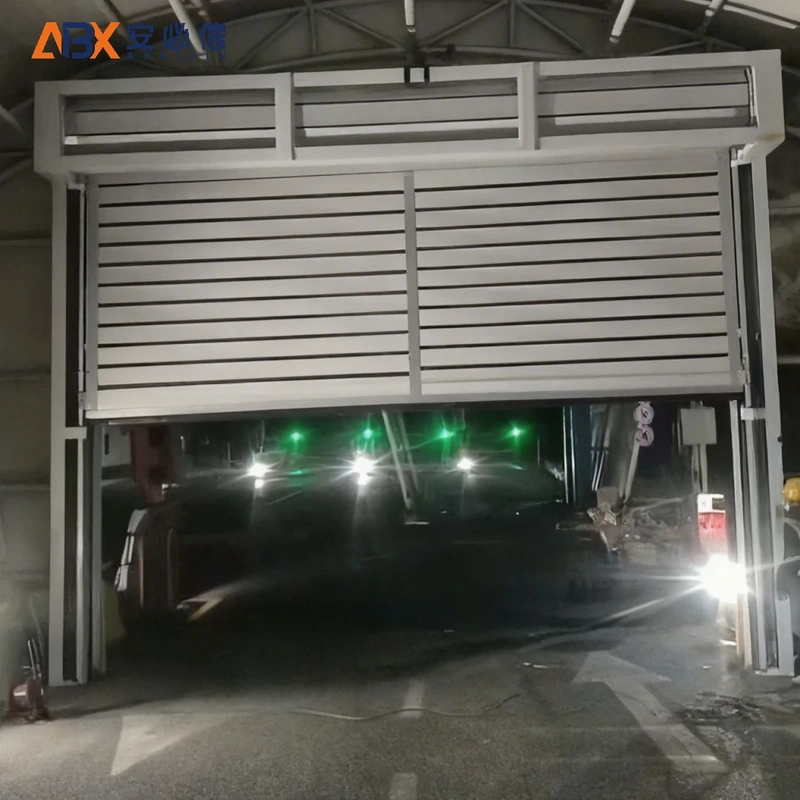
A metal high-speed door is a rigid slat door built from steel slats in a reinforced guide. The heavier leaf resists impact and abrasion in industrial traffic, and the drive, the balance system and the fixing detail are sized for the additional mass rather than for a light alloy leaf.
What steel slats buy and what they cost
Steel slats tolerate contact that would deform an aluminium leaf. In plants where forklifts, carts or tow trains pass close to the opening, that tolerance shows up as fewer damaged leaves and shorter out-of-service periods.
The cost is mass. A heavier leaf needs a stronger guide, a larger drive, a more robust balance system and a header structure that can carry the parked package. Those items are part of the door price, so a comparison based on leaf price alone is misleading.
The impact cases worth designing for
Most damage on an industrial opening follows a small number of patterns. Specifying for those patterns is more useful than asking for a general heavy-duty leaf.
| Impact case | What is damaged first | Design response |
|---|---|---|
| Forklift mast clips the closed leaf | Slat face and hinge line | Reinforced slat face, captive guide, replaceable slat sections |
| Load strikes the guide while the door opens | Guide profile and carrier | Heavier guide section with replaceable wear strips |
| Pallet pushed through the closing leaf | Bottom seal and bottom slat | Monitored bottom edge with fast reversal, spare bottom slat on site |
| Repeated abrasion from pallets at the threshold | Threshold plate and floor finish | Replaceable threshold plate, floor repair detail |
Guide, balance and drive sizing
The guide carries both the weight of the leaf and the lateral load from wind or impact. In a steel construction the guide section is normally one size above the equivalent alloy door, and the wear strips are replaceable so that the structural profile is not consumed.
Balance is set with the door in mid-travel, and it is checked again after any slat replacement. An unbalanced heavy door loads the gearbox and the brake on every cycle, and the brake is usually the first component to show the effect.
Finishing and corrosive environments
Steel needs a finish that survives the local atmosphere. In food plants the relevant attack is washdown chemistry; in coastal or chemical sites it is airborne salt or acid. The finish specification should name the exposure, not just a colour.
Cut edges, fixings and the interface between dissimilar metals are where corrosion starts. A specification that covers the leaf face but leaves the guide and the threshold untreated will show rust at those points within a few seasons.
Service items and spares to hold
Because the leaf is repairable rather than replaceable, the spare parts list is part of the specification. Holding a small number of slats, a bottom seal and a set of guide wear strips converts a multi-day stoppage into a shift-level repair.
- Two or three slat sections of the installed profile.
- One bottom seal of the correct width and profile.
- A set of guide wear strips and carrier rollers.
- A spare photocell pair and a safety edge if the process cannot tolerate a bypass.
The threshold under heavy loads
A steel leaf is usually chosen where loads are heavy, and the threshold takes the same punishment as the leaf. A cast or fabricated threshold plate distributes wheel loads into the floor slab; a plate fixed with light anchors works loose within a season and then damages the bottom seal on every cycle.
The floor finish either side of the plate matters as much. A patch repair that stands a few millimetres proud of the surrounding slab acts as a ramp for the seal and wears it through at one point. Specifying a replaceable plate with a flush finish, and recording the floor level at the threshold, prevents the most common early failure on a heavy door.
Related guides in this series
The following pages cover the adjacent decisions in the same product family, so the specification can be reviewed end to end.
- Complete guide to rigid high-speed doors
- Aluminium doors for wide openings
- Preventive maintenance schedule
- Rigid versus sectional overhead doors
References to verify before ordering
The table lists the references that normally change the selected configuration. It is a specification checklist, not a certification statement for any particular installation; the applicable class is confirmed against the measured opening and the site conditions.
| Reference | What has to be confirmed |
|---|---|
| EN 12604 | Mechanical strength and fixing loads of a heavy leaf |
| EN 12424 | Wind class where the opening is external |
| EN 12453 | Safety in use, including force limits on a heavy leaf |
| EN 13241 | Product standard for the assembly |
| EN ISO 12944 | Corrosion protection classification for the steel finish |
Frequently asked questions
Why choose steel instead of aluminium slats?
Steel tolerates impact and abrasion better and can be repaired slat by slat. It is chosen where vehicles pass close to the opening or where the atmosphere attacks lighter materials.
Does a heavier door open more slowly?
The drive is sized for the leaf mass, so the achievable speed depends on the model rather than on the material alone. A heavy leaf generally needs a larger drive to reach the same opening speed.
What finish should be specified?
One that names the exposure: washdown chemistry, coastal salt or chemical atmosphere. The guide, threshold and fixings need the same treatment as the leaf face.
How often should a heavy door be serviced?
The interval follows the logged cycle count and the site atmosphere. Heavy doors on high-cycle routes are normally inspected more often than light doors on the same schedule.
Gallery