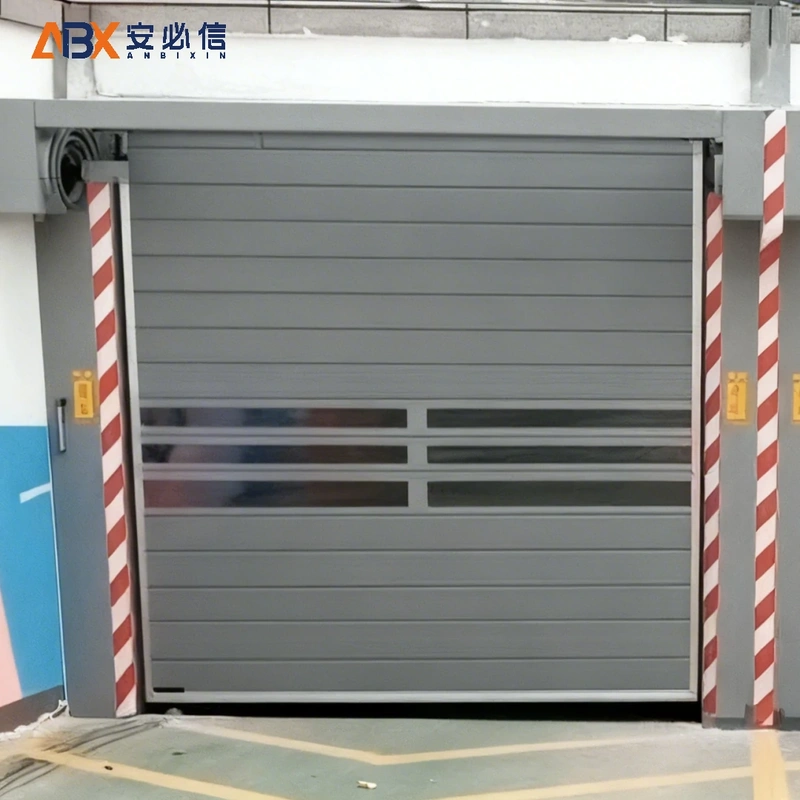
A fire-rated high-speed door is a power-operated industrial door that provides a declared fire resistance while operating as a fast traffic door in normal service. On a fire signal it closes and latches to restore the compartment boundary, so the control system, the closing mechanism and the test record are part of the product.
What the rating actually covers
A fire rating is a statement about a tested assembly, not about a leaf material. The declared performance covers the door, its frame, its fixings and the way it meets the surrounding construction. Changing any of those elements invalidates the tested configuration unless the change is covered by an assessment.
The rating is also directional and time-limited: integrity, insulation and radiation are separate criteria, and the period applies to a defined test exposure. A specification that asks for a rating without naming the criterion and the period cannot be verified.
Normal service and fire service are two modes
In normal service the door behaves like any high-speed door: traffic commands, safety devices and interlocks. On a fire signal it must ignore normal commands and close under its own control.
- The fire signal overrides open commands from detectors, loops and manual stations.
- The closing sequence runs at a controlled speed to avoid trapping anyone under the leaf.
- The door latches and reports its state to the fire panel.
- A reset requires a deliberate action at the panel, not a cycle of the traffic controller.
Detectors, hold-open and the daily conflict
In a busy plant the door is open most of the day, which is exactly the condition a compartment boundary is meant to prevent. The practical solution is a hold-open arrangement released by the fire alarm, not a door that is manually propped.
Where the door is held open for traffic, the release mechanism, the detector coverage and the closing path all have to be tested together. A door that closes on signal but meets a pallet in the aperture has not restored the boundary.
The test record and its maintenance
A rated door is only valid while its closing function works. The routine test releases the door from its normal mode, measures the closing time, confirms the latch engages and records the result.
| Test | What is confirmed | Interval basis |
|---|---|---|
| Full closure from open position | Closing time, latch engagement, no obstruction | Period set by the site fire strategy |
| Release mechanism | Hold-open releases on signal, no manual intervention | Each test |
| Safety during closing | Bottom edge reverses while the fire signal stays active | Each test |
| Panel reporting | Door state visible and correct at the fire panel | Each test |
| Fixings and seals | Frame intact, intumescent seals undamaged | Annual inspection |
Where a rated high-speed door is the wrong answer
If the opening is not a compartment boundary, a rating adds cost and a testing obligation without benefit. If the wall itself is not rated, a rated door in an unrated wall does not create a compartment. And if the required period exceeds what a moving leaf can achieve, a different boundary strategy is needed.
What the fire strategy needs from the door
The fire strategy document defines the compartment line, the required period and the acceptable closing time. The door supplier needs those three figures, plus the position of the detectors that release the door and the route the closing leaf will take.
Two details are frequently missed. The first is the interface with the fire panel: who resets the door, and how the reset is recorded. The second is the interaction with the traffic system: a door that is commanded open by a radar while the panel is in alarm has not restored the compartment, so the alarm must take priority in the control logic rather than in the operating procedure. Both belong in the commissioning record, and both are checked at each periodic test.
Related guides in this series
The following pages cover the adjacent decisions in the same product family, so the specification can be reviewed end to end.
- Complete guide to rigid high-speed doors
- Safety devices and EN 12453
- Drive, control and commissioning
- Metal doors for heavy traffic
References to verify before ordering
The table lists the references that normally change the selected configuration. It is a specification checklist, not a certification statement for any particular installation; the applicable class is confirmed against the measured opening and the site conditions.
| Reference | What has to be confirmed |
|---|---|
| EN 13241 | Product standard, including the fire performance declaration |
| EN 12453 | Safety in use during the closing sequence |
| EN 12604 | Mechanical aspects of the leaf, frame and fixings |
| EN 13501-2 | Classification of the fire resistance of the assembly |
| EN 12424 | Wind class where the door is also an external closure |
Frequently asked questions
Does a fire-rated high-speed door stay closed all day?
No. It operates as a normal traffic door and closes on a fire signal. Where it is held open for traffic, the hold-open must be released by the alarm system and tested as part of the fire strategy.
What rating period can be achieved?
It depends on the tested assembly and the criteria required. The specification has to name the criterion and the period, and the supplier has to evidence both for the exact configuration being installed.
Can the door be used for security as well?
It closes and latches, so it contributes to the compartment boundary, but a security rating is a separate declaration and should be specified separately.
How often should the closing function be tested?
At the interval set by the site fire strategy, and after any change to the detectors, the hold-open arrangement or the controller. The result is recorded each time.
Gallery