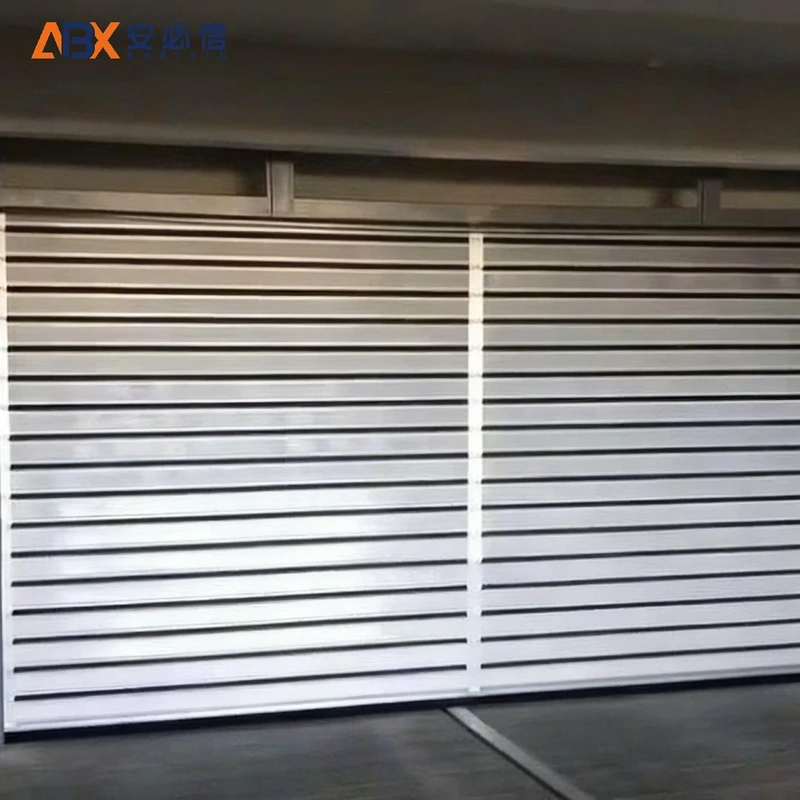
An unplanned stop on a rigid high-speed door is a cycle that did not complete, and diagnosis is the process of separating a control fault from a mechanical one. The controller fault log, the position at which the door stopped and the recent history of the door narrow the cause faster than any component swap.
Start with where it stopped
The position of the leaf when the fault occurred is the most informative single fact. A stop near the closed position points to the bottom seal, the threshold or the reversal setting. A stop near the open limit points to the guide, the park position or the balance.
| Stopped at | Likely cause | First check |
|---|---|---|
| Just above the floor | Bottom edge force, threshold obstruction, seal drag | Test piece reversal, floor condition |
| Mid-travel | Guide obstruction, roller failure, drive overload | Guide wear strips, roller condition, motor current |
| At the open limit | Park position adjustment, balance, limit switch | Parked package clearance, holding force |
| Random positions | Loose wiring, photocell contamination, controller fault | Fault log, terminal tightness, lens condition |
The five causes that cover most cases
On a door that was previously reliable, a small number of causes accounts for most stoppages. The list below is the order in which they are usually found.
- Contaminated or misaligned photocells, often after cleaning or a knock.
- A bottom seal that has lost its air pressure or is dragging on a raised floor edge.
- Guide wear strips worn or displaced, so the leaf runs tight.
- An unbalanced door, which overloads the drive at one end of the travel.
- A safety edge or interlock input that is intermittently open.
These account for most stoppages on a door that was previously reliable. A door that fails repeatedly at the same position usually has an alignment problem rather than a component failure.
Reading the fault log properly
The log records the input that stopped the cycle, not the reason it was active. A reversal triggered by the bottom edge may be caused by a floor obstruction, a seal defect or a sensitivity setting that is too tight; the log shows only the trigger.
Comparing the fault count with the cycle count gives a failure rate, which is more useful than a raw number. Ten faults in 50,000 cycles is a different problem from ten in 500.
When it is a mechanical problem
Noise that changes with position, a leaf that hesitates at one point in the travel or a visible gap at the seal indicate mechanical wear. Those are found by moving the door slowly through its travel and observing the guides, not by reading the log.
Preventing the repeat
Every diagnosis should end with a change: a cleaning interval, a seal replacement, a guide adjustment or a sensitivity setting. A repair that only resets the fault will recur at the same cycle count.
When to stop adjusting and call the supplier
Adjustment solves alignment problems and hides design problems. If a door needs its reversal sensitivity loosened at every service visit, or its closing delay extended to avoid nuisance reversals, the underlying cause is usually a seal that no longer compresses evenly or a guide that has moved.
The point to escalate is when the same fault returns within one service interval at a similar cycle count. At that stage the useful information is the fault log, the position of the stop and the measurements taken at the last two visits. With those three items a supplier can identify a component or an installation defect; without them the visit becomes another adjustment.
Related guides in this series
The following pages cover the adjacent decisions in the same product family, so the specification can be reviewed end to end.
- Preventive maintenance schedule
- Drive, control and commissioning
- Safety devices and EN 12453
- Metal doors and impact damage
References to verify before ordering
The table lists the references that normally change the selected configuration. It is a specification checklist, not a certification statement for any particular installation; the applicable class is confirmed against the measured opening and the site conditions.
| Reference | What has to be confirmed |
|---|---|
| EN 12453 | The reversal function that generates most fault entries |
| EN 12978 | Condition of the protective devices that stop the cycle |
| EN 12604 | Mechanical clearances that cause drag and overload |
| EN ISO 13849-1 | Control behaviour when an input is intermittently open |
| EN 13241 | Manufacturer's fault codes and service limits |
Frequently asked questions
The door stops at the same height every day. What does that mean?
A position-dependent stop points to a mechanical cause: a guide defect, a floor obstruction or a seal that drags at that point. It is rarely a controller fault.
Why does the door reverse for no apparent reason?
Usually a contaminated photocell, a bottom edge losing pressure or a sensitivity setting that is too tight. The fault log shows which input triggered the reversal.
Should the safety edge be bypassed to keep production running?
No. A bypass removes the compliance basis and hides the cause. A temporary documented procedure with an alternative safeguard is the only acceptable route.
How many faults per thousand cycles is normal?
A well-maintained door should complete tens of thousands of cycles between faults. A rate above one per few thousand cycles indicates a persistent alignment or seal problem.
Gallery